
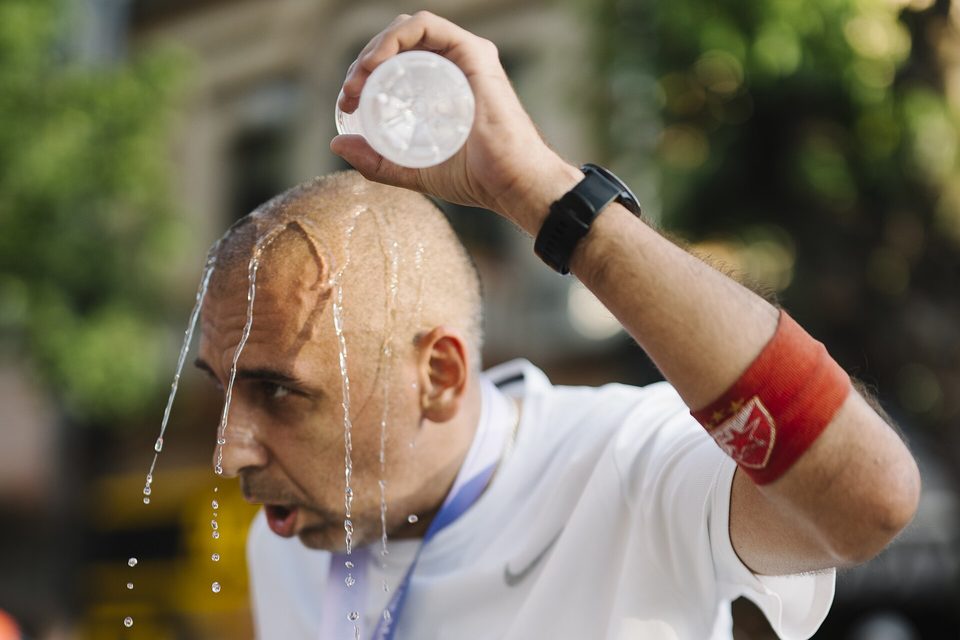
The women's marathon at the 2019 World Athletics Championships in Doha was run in 32°C (about 90°F) and 74% humidity. Researchers who later studied the race found that 41% of the field failed to finish, a rate they called unprecedented.
Heat doesn't care how fit you are. But your body can learn to handle it, and the research on how it learns, how fast, and how quickly it forgets is some of the most practical in sports science. If you train through an Austin summer, race in the Caribbean, or play in August, this is your science.
What Heat Does to a Working Body
Exercise makes heat. Most of the energy your muscles burn comes out as heat, not motion, and in hot, humid air your body has a harder time getting rid of it. To cool down, it sends more blood to the skin and makes more sweat. That leaves less blood for the working muscles, so your heart has to beat faster to keep up, and the same pace starts to feel much harder.
That is the cost of training in the heat. Heat acclimatization is how your body lowers it.
What Changes When You Adapt
When you train in the heat repeatedly, your body makes a set of changes researchers have measured for decades. A 2015 review lists them: better sweating, better blood flow to the skin, lower body temperatures, less strain on the heart and blood vessels, and better fluid balance.
In plain terms:
- More blood plasma. Your blood volume grows, which helps your heart pump more with each beat.
- A lower heart rate at the same effort.
- A lower core temperature during exercise.
- More sweat, sooner, and less salty. In one 2015 study, ten days of heat training raised sweat output by about 26% and cut the sodium in that sweat by about 19%. Plasma volume rose about 6%.
The saltier-to-less-salty shift matters. Your body learns to sweat more while holding on to more of its sodium.
How Fast It Works
Faster than most people expect. A 1998 review found that about two-thirds to 75% of the improvements show up in the first 4 to 6 days, and adaptation is nearly complete after 7 to 10 days.
Not everything moves at the same speed. A 2018 analysis of the research found that five or more days are enough to lower heart rate and core temperature, while sweating keeps improving the longer you keep going.
The international consensus recommendations on training and competing in the heat, published in 2015, turn this into a simple plan: repeated training sessions in the heat over 1 to 2 weeks, each lasting at least 60 minutes and hard enough to raise your body temperature and get you sweating. They also make a point that is easy to miss: athletes adapt mainly to the conditions they train in. Humid heat and dry heat are not the same, so prepare in conditions like the ones you will race in.
Being fit gets you part of the way there, but not all of it. The same 1998 review found that highly fit people are only partly acclimatized to heat. Fitness is a head start, not a substitute.
How Fast You Lose It
Heat adaptation fades when you stop, but more slowly than it builds. The 2015 consensus says most of the benefits, like a lower heart rate and core temperature, hold for 2 to 4 weeks.
The 2018 analysis put a number on the fade: for every day without heat exposure, about 2.5% of the heart rate and core temperature adaptations are lost. The good news is in the same paper: getting the adaptation back was 8 to 12 times faster than losing it. Once you have done the work, a short refresher brings you back.
Does It Make You Faster?
In the heat, yes. A 2016 meta-analysis of 96 studies found that heat adaptation had a moderately beneficial effect on performance in hot conditions, whatever the method, and that longer programs worked better.
In cool weather, the answer is less clear. In a 2010 study of 12 trained cyclists, ten days of heat training raised their maximum oxygen uptake by 5% and their time trial performance by 6% in cool conditions. But a 2015 study found no change in either one at 18°C after heat training, and its title says so outright: heat training increased capacity "in hot but not in temperate conditions." For now, treat heat training as preparation for the heat, and any boost in cool weather as a possible bonus.
What Doha Showed
The 2019 Championships became a natural experiment. Researchers measured athletes' core temperatures during the road races in Doha. Those who had done 5 to 30 days of heat acclimation beforehand ranked better on average (18th versus 28th) and ran with lower peak core temperatures than those who hadn't.
A related study of the same championships found that ice vests were the most popular way to cool down before racing, and the only cooling method linked with lower core temperatures.
You can't control the weather on race day. You can control whether your body has seen it before.
What It Means for You
Plan two weeks out. If your race or season opener is somewhere hot, give yourself 1 to 2 weeks of regular training in similar conditions. Most of the gains come in the first week.
Ease in. Start shorter and easier in the heat and build up across the first several sessions.
Learn your sweat rate. The American College of Sports Medicine suggests weighing yourself before and after training to estimate how much fluid you lose. Sweat rates vary a lot from person to person: the 2015 consensus says 1.0 to 1.5 liters an hour is common, and some people top 2.5. The ACSM's goal is to avoid losing more than 2% of your body weight to dehydration.
Cool down before you start. A 2015 meta-analysis found that cooling before or during exercise improved performance in the heat by about 7% on average. Most of those studies were done in labs, though, and the consensus notes that real-world gains outdoors may be smaller.
Don't wait for race week. The fade is slow, so heat training a few weeks out still counts, and a few sessions close to the event bring it back fast.
If you are racing St. Croix's Beauty and the Beast Triathlon on November 27, or anything else in Caribbean heat, the window to start is now.
Sources
Racinais S et al. Consensus recommendations on training and competing in the heat.British Journal of Sports Medicine, 2015.PubMed
Périard JD et al. Adaptations and mechanisms of human heat acclimation: applications for competitive athletes and sports. Scandinavian Journal of Medicine and Science in Sports, 2015.PubMed
Pandolf KB. Time course of heat acclimation and its decay. International Journal of Sports Medicine, 1998.PubMed
Daanen HAM et al. Heat acclimation decay and re-induction: a systematic review and meta-analysis. Sports Medicine, 2018.PubMed
Keiser S et al. Heat training increases exercise capacity in hot but not in temperate conditions. American Journal of Physiology: Heart and Circulatory Physiology, 2015.PubMed
Tyler CJ et al. The effects of heat adaptation on physiology, perception and exercise performance in the heat: a meta-analysis. Sports Medicine, 2016.PubMed
Lorenzo S et al. Heat acclimation improves exercise performance. Journal of Applied Physiology, 2010.PubMed
Beal H et al. Marathon performance and pacing in the Doha 2019 women's IAAF World Championships. International Journal of Sports Physiology and Performance, 2022.PubMed
Racinais S et al. Association between thermal responses, medical events, performance, heat acclimation and health status in male and female elite athletes during the 2019 Doha World Athletics Championships. British Journal of Sports Medicine, 2022.PubMed
Racinais S et al. Hydration and cooling in elite athletes during the Doha 2019 IAAF World Athletics Championships. British Journal of Sports Medicine, 2021.PubMed
Sawka MN et al. American College of Sports Medicine position stand: exercise and fluid replacement. Medicine and Science in Sports and Exercise, 2007.PubMed
Bongers CC et al. Precooling and percooling (cooling during exercise) both improve performance in the heat: a meta-analytical review. British Journal of Sports Medicine, 2015.PubMed