
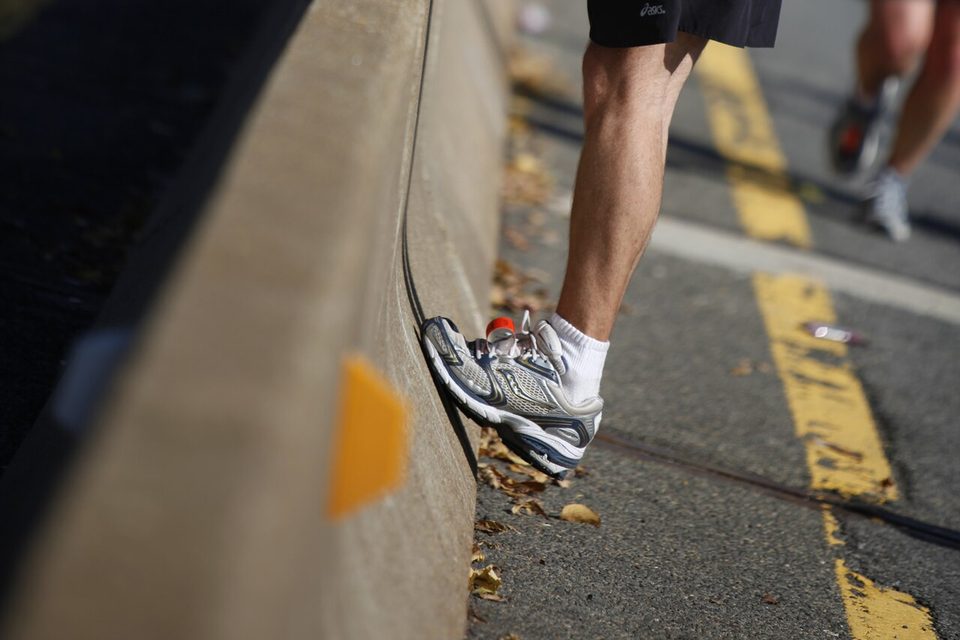
It happens in the last ten minutes of a hot match, at mile 20 of a marathon, or in the final set of a long tennis rally. A calf or hamstring suddenly locks up, hard and painful, and refuses to let go. You hobble, you stretch, and someone on the sideline hands you a sports drink and tells you that you didn't hydrate enough.
That advice has been around for generations. The trouble is that when researchers went looking for proof, it mostly wasn't there.
The Old Story: Water and Salt
The classic explanation goes like this: you sweat out water and salts like sodium, the balance in your body shifts, and your muscles start misfiring. Fix the fluids and you fix the cramp.
It sounds sensible, and severe dehydration and salt loss are real medical problems. But in 2009, Martin Schwellnus of the University of Cape Town reviewed the research behind that story for cramps during exercise. Much of the support, he found, came from anecdotes, a handful of case reports, and one small study of ten people. When researchers followed larger groups of athletes forward in time, in four separate studies, the dehydration and electrolyte theories didn't hold up.
The Ironman Test
Schwellnus and his colleagues then ran one of the clearest tests. They followed 210 athletes through an Ironman triathlon, weighing them and taking blood samples before and right after the race.
Forty-three of them cramped. When the researchers compared them with the athletes who didn't, there was no meaningful difference in their blood salt levels or in how much body weight (mostly water) they lost.
Two things did predict cramping. The athletes who cramped had raced faster than the others, even though both groups had similar training and race histories. And they were more likely to have cramped in recent races before. Going harder than usual, and a history of cramps, mattered more than water or salt.
The cramps showed up in the athletes who pushed the pace, not the ones who ran dry.
The New Story: Tired Nerves
The explanation that fits the evidence best is called altered neuromuscular control. Every muscle is run by a conversation between nerves that tell it to contract and nerves that tell it to ease off. Sensors in the muscle report how hard it is working and how stretched it is, and the spinal cord balances the signals.
When a muscle is worked hard and gets tired, that balance can tip. The "contract" signals get louder and the "relax" signals get quieter, until the muscle fires on its own and won't stop. That fits who cramps: athletes going faster than usual, deep into an event, in the muscles doing the most work, like calves and hamstrings.
It also explains why the oldest cramp fix works. Stretching the muscle gently puts tension on its tendon, which is thought to send a calming signal back to the spinal cord and help switch the cramp off.
The Pickle Juice Experiment
Coaches and trainers had sworn for years that a swig of pickle juice stops cramps. In 2010, a research team led by Kevin Miller decided to test it.
They dehydrated a group of men until they had lost about 3% of their body weight, then used a mild electrical current on a nerve to trigger a cramp in a small muscle in the foot. When the men drank a small amount of plain water, the cramp lasted about 134 seconds. With the same amount of pickle juice, about 85 seconds: roughly 49 seconds shorter.
Here is the twist. Blood tests five minutes later showed that neither drink had meaningfully changed the fluids or salts in their blood. The pickle juice worked far too fast to have been absorbed. The researchers' best explanation is a reflex: the sharp taste in the mouth and throat triggers a nerve signal that tells the cramping muscle to stand down.
In other words, even the famous salty fix seems to work through the nervous system, not the gut.
What This Means for You
Keep drinking. Staying hydrated still matters for performance and for your health in the heat. It just isn't the whole cramp story.
Train for your race pace. Cramps tend to show up when you go harder or longer than your muscles are used to. Building up to race intensity in training gives them a fair shot.
Know your history. If you cramped in your last few races, you are more likely to cramp again. Pacing and preparation are your first tools.
When it hits, stretch. Ease the muscle into a gentle, steady stretch and hold it.
Cramps that are frequent, happen at rest, or come with other symptoms are a different matter and worth a conversation with a doctor.
The next time a calf locks up in the closing minutes, it probably isn't telling you that you forgot your water bottle. It is telling you that you pushed hard enough for your nervous system to lose the balance for a moment. That is not failure. It is a signal to train for the pace you want to race at.
Sources
Schwellnus MP. Cause of exercise associated muscle cramps (EAMC): altered neuromuscular control, dehydration or electrolyte depletion? British Journal of Sports Medicine, 2009.PubMed
Schwellnus MP, Drew N, Collins M. Increased running speed and previous cramps rather than dehydration or serum sodium changes predict exercise-associated muscle cramping: a prospective cohort study in 210 Ironman triathletes. British Journal of Sports Medicine, 2011.PubMed
Miller KC et al. Reflex inhibition of electrically induced muscle cramps in hypohydrated humans. Medicine and Science in Sports and Exercise, 2010.PubMed