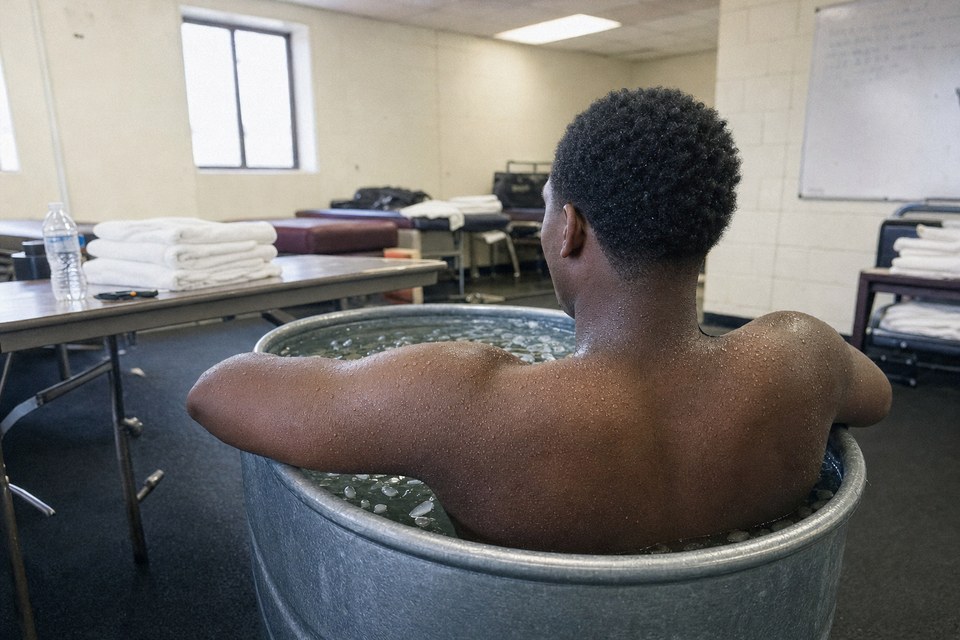
Walk into almost any pro locker room or college training room and you will find a tub of freezing water. Ice baths have become part of the uniform of serious recovery, and social media has turned them into a lifestyle.
The research on them is more interesting than either side of the argument. Cold water does some things well, does some things poorly, and in one important situation may work against you.
What Counts as an Ice Bath
In the research, an ice bath is called cold-water immersion: sitting in water colder than about 15°C (59°F), usually up to the waist or chest, after exercise. The studies vary a lot in how cold and how long. A 2016 meta-analysis found the best results for soreness with water around 10 to 15°C (50 to 59°F) for about 10 to 15 minutes. A 2026 review of 15 meta-analyses landed in a similar place: 10 to 15 minutes, in water between about 5 and 15°C.
Colder and longer is not automatically better. A 2023 analysis found the soreness benefit showed up with short and medium soaks, not long ones.
Does It Help Soreness?
Yes, modestly. A Cochrane review pooled 17 small trials and found that people who used cold water after exercise reported less muscle soreness than people who simply rested, from 24 hours out through four days later. The authors were careful to note that the trials were small and of low quality, so the size of the effect is uncertain.
Newer work points the same way. A 2022 meta-analysis of 52 studies found that 24 hours after high-intensity exercise, people who used cold water felt less sore and felt more recovered than those who rested passively. A 2023 analysis comparing cold water with other methods found it beat active recovery, contrast baths and warm water for soreness.
Does It Help You Perform Again?
This is where it gets mixed. The 2022 meta-analysis found cold water helped muscular power come back 24 hours after hard exercise, but made no clear difference to strength.
Timing matters, too. Another 2022 analysis of 68 studies found that cold water actually hurt sprint performance one hour later and jump performance six hours later, then helped jump and strength recovery at 24 hours and beyond. If you have to perform again within a few hours, an ice bath right before may not be your friend.
The Catch: Strength Training
Here is the part most people never hear. In a 2015 study, 21 active men did strength training twice a week for 12 weeks. After every session, half sat in cold water for 10 minutes and half did an easy active cool-down. At the end, the active cool-down group had gained more strength and more muscle. Their fast-twitch muscle fibers had grown about 17%; the cold water group's had not grown significantly.
A 2019 study found something similar: regular cold water after lifting reduced how much the fast-twitch fibers grew, though strength gains in that study were similar between groups. And a 2021 meta-analysis of eight studies found that regular cold water after strength training had a negative effect on gains in maximum strength and explosive efforts. It found no such effect on endurance training.
Why would cold get in the way? After a hard lifting session, muscle switches on the signals that tell it to rebuild bigger and stronger. The 2015 study found that cold water dampened those signals in the two days after training. Interestingly, it is probably not about inflammation: a 2017 study found that cold water and an active cool-down left similar levels of inflammation in the muscle.
An ice bath helps you feel ready for tomorrow. Used after every lift, it may cost you some of what you were training for.
When Athletes Use It
The researchers' answer is not "never" and not "always." It is "on purpose." A 2021 review suggested using cold water during competition or very heavy blocks of training, when feeling fresh for the next session matters most, and skipping it after sessions meant to build strength or muscle. The 2026 review of reviews reached the same conclusion: use it for a reason, not by routine.
Even in tournaments the benefit is not guaranteed. In a real five-day youth field hockey tournament, daily cold water did not improve match performance or how recovered players felt. In a simulated tournament, it helped sprint speed recover 24 hours after the last session, but did little to manage the overall strain.
What It Means for You
Game week or tournament? Cold water after a hard game or between rounds may help you feel less sore and recover some power by the next day.
Building strength or muscle? Skip the tub after those sessions. A light active cool-down is the better habit when gains are the goal.
Need to perform again soon? Studies found cold water can slow sprint and jump performance for the first few hours. Save it for after you are done.
Keep it short. In the studies, about 10 to 15 minutes in water around 10 to 15°C was the sweet spot. Longer was not better.
Sources
Bleakley C et al. Cold-water immersion (cryotherapy) for preventing and treating muscle soreness after exercise. Cochrane Database of Systematic Reviews, 2012.PubMed
Machado AF et al. Can water temperature and immersion time influence the effect of cold water immersion on muscle soreness? Sports Medicine, 2016.PubMed
Batista NP et al. What parameters influence the effect of cold-water immersion on muscle soreness? Clinical Journal of Sport Medicine, 2023.PubMed
Moore E et al. Impact of cold-water immersion compared with passive recovery following a single bout of strenuous exercise on athletic performance. Sports Medicine, 2022.PubMed
Moore E et al. Effects of cold-water immersion compared with other recovery modalities on athletic performance. Sports Medicine, 2023.PubMed
Choo HC et al. The effect of cold water immersion on the recovery of physical performance revisited. Journal of Sports Sciences, 2022.PubMed
Berjisian E et al. Strategic application of post-exercise cold-water immersion: an umbrella review. Sports Medicine Open, 2026.PubMed
Roberts LA et al. Post-exercise cold water immersion attenuates acute anabolic signalling and long-term adaptations in muscle to strength training. Journal of Physiology, 2015.PubMed
Fyfe JJ et al. Cold water immersion attenuates anabolic signaling and skeletal muscle fiber hypertrophy, but not strength gain. Journal of Applied Physiology, 2019.PubMed
Malta ES et al. The effects of regular cold-water immersion use on training-induced changes in strength and endurance performance. Sports Medicine, 2021.PubMed
Peake JM et al. The effects of cold water immersion and active recovery on inflammation and cell stress responses in human skeletal muscle after resistance exercise. Journal of Physiology, 2017.PubMed
Ihsan M et al. Adaptations to post-exercise cold water immersion: friend, foe, or futile?Frontiers in Sports and Active Living, 2021.PubMed
Leeder JDC et al. Cold water immersion improves recovery of sprint speed following a simulated tournament. European Journal of Sport Science, 2019.PubMed
Krueger M et al. The physiological effects of daily cold-water immersion on 5-day tournament performance in international standard youth field-hockey players.European Journal of Applied Physiology, 2020.PubMed