
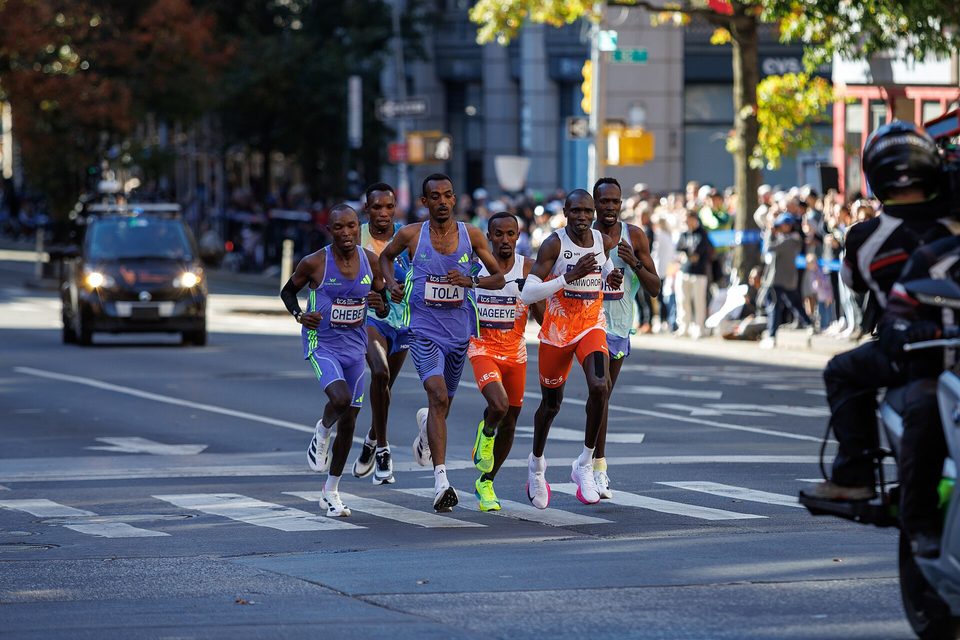
Put a marathon winner next to an Olympic 100-meter finalist and you can see some of the difference from the stands: one is lean and light, the other carries more muscle. But the bigger difference is one you can't see at all. It is inside the muscle, fiber by fiber.
Every skeletal muscle in your body is a bundle of long, thin cells called muscle fibers. They don't all behave the same way. Some are built to work for hours. Others are built to fire hard and fast for a few seconds. The mix you carry shapes what kind of athlete you are, and how quickly you feel the burn.
The Three Main Types
Scientists sort human muscle fibers by the version of a motor protein, myosin, that each one uses. There are three main types:
Type I (slow twitch). Slower to contract, but packed with mitochondria and fed by lots of small blood vessels. They run mostly on oxygen and can keep going for a long time. These are your endurance fibers.
Type IIa (fast twitch). Faster and more forceful, with a decent ability to use oxygen too. Think of them as the middle gear.
Type IIx (fast twitch). The fastest and most powerful, and the quickest to tire. They lean on fast, oxygen-free energy and tire quickly.
Many fibers are also hybrids that carry more than one type of myosin, which is part of why the picture is messier than a simple fast versus slow split.
Slow fibers are the diesel engine. Fast fibers are the turbo.
What the Needle Showed
In the 1970s, the exercise scientist David Costill and colleagues took small muscle samples, with a biopsy needle, from the calves of men and women on track teams and from people who didn't train. Then they stained thin slices so each fiber type showed up in a different shade.
Sprinters and distance runners came out clearly different: the sprinters were built around fast-twitch fibers, the distance runners around slow-twitch ones, with matching differences in the enzymes their muscles used for energy. One group didn't fit the pattern. Shot-putters, who need raw strength more than speed or stamina, had a wide mix of fiber types and relatively low enzyme activity.
The researchers' conclusion is still the starting point today: an athlete's leaning toward speed, strength, or endurance is partly a matter of what they were born with.
How Much Is Born, How Much Is Built
People vary a lot. A 1995 review from Laval University in Quebec found that about one in four North American adults it covered have either less than 35% or more than 65% slow-twitch fibers in the main thigh muscle. Most sit somewhere in the middle.
The same review estimated where that variation comes from: about 45% from inherited factors, about 40% from environment, including how the muscle is used, and the rest from the limits of measuring a muscle with a small sample.
So genes set the starting point, but training still matters. A 2021 review of the research found that cross-sectional studies show big differences between athlete groups, while studies that follow the same people over time are less consistent. The best methods do show that fibers can shift, both between hybrid and pure types and between slow and fast. How far, and under what kind of training, is still being worked out.
The Speed Gene That Isn't the Whole Story
In 2003, Australian researchers looked at a gene called ACTN3. It makes a protein, alpha-actinin-3, that is found only in fast-twitch fibers. About 18% of the white population they studied carry two copies of a common variant that switches the protein off completely, and they live perfectly healthy lives. But elite sprinters, men and women, were significantly more likely to carry the working version.
It was quickly nicknamed the speed gene. Then researchers went to Jamaica.
A 2010 study compared 116 elite Jamaican sprinters and 114 elite US sprinters with people from the same populations. The version of ACTN3 that switches the protein off was rare in everyone: about 2% to 4% of athletes and non-athletes alike. Since almost all Jamaicans carry the working version, the gene can't explain why Jamaica produces so many great sprinters. The same study found no link with another well-known candidate, the ACE gene.
The lesson travels well across the Caribbean. WhenJulien Alfred won Saint Lucia's first Olympic medal (gold, in the 100 meters), she did it with years of coaching, competition, and work on top of whatever her muscles started with. Fiber type and genes open the door. They don't run the race.
Why Fast Fibers Feel the Burn First
Fast-twitch fibers are built to break down fuel quickly without waiting for oxygen. That speed comes at a price. As we covered inour piece on the burn, fast energy releases hydrogen ions, and as they build up, muscle pH drops and contractions start to weaken.
Muscle has a built-in answer: its own buffers, which soak up acid inside the muscle cell. Sprinters and rowers, whose muscles lean fast, have more of that buffering capacity than marathoners do. The athletes whose muscles make the most acid come with the most protection against it.
What It Means for You
You can't order a muscle biopsy before picking a sport, and you don't need one. Your training already tells you a lot. If you can grind for hours but fade in a sprint finish, you probably lean slow. If you are explosive for ten seconds and cooked after a minute, you probably lean fast.
Either way, everyone has all three types, and every sport uses all of them at some point: a midfielder jogging for 80 minutes and sprinting for the ball, a marathoner kicking down the final straight. Train for the event you love, train the fibers you are weakest in, and respect the burn when it shows up. It is your fast fibers doing exactly what they were built to do.
Sources
Costill DL et al. Skeletal muscle enzymes and fiber composition in male and female track athletes. Journal of Applied Physiology, 1976.PubMed
Simoneau JA, Bouchard C. Genetic determinism of fiber type proportion in human skeletal muscle. FASEB Journal, 1995.PubMed
Plotkin DL et al. Muscle fiber type transitions with exercise training: shifting perspectives. Sports, 2021.PubMed
Yang N et al. ACTN3 genotype is associated with human elite athletic performance.American Journal of Human Genetics, 2003.PubMed
Scott RA et al. ACTN3 and ACE genotypes in elite Jamaican and US sprinters.Medicine and Science in Sports and Exercise, 2010.PubMed
Parkhouse WS et al. Buffering capacity of deproteinized human vastus lateralis muscle.Journal of Applied Physiology, 1985.PubMed